
New Development Tree Care
From planting day
to a mature canopy.
For developers, builders, and new communities and commercial sites in Jonesboro and Northeast Arkansas (NEA), Memphis, Little Rock, Bentonville, and surrounding areas. Large new plantings, planted right and cared for until they’re established and growing on their own, with every tree on the map.

A program, not a planting day
Most new trees are won or lost in the first years.
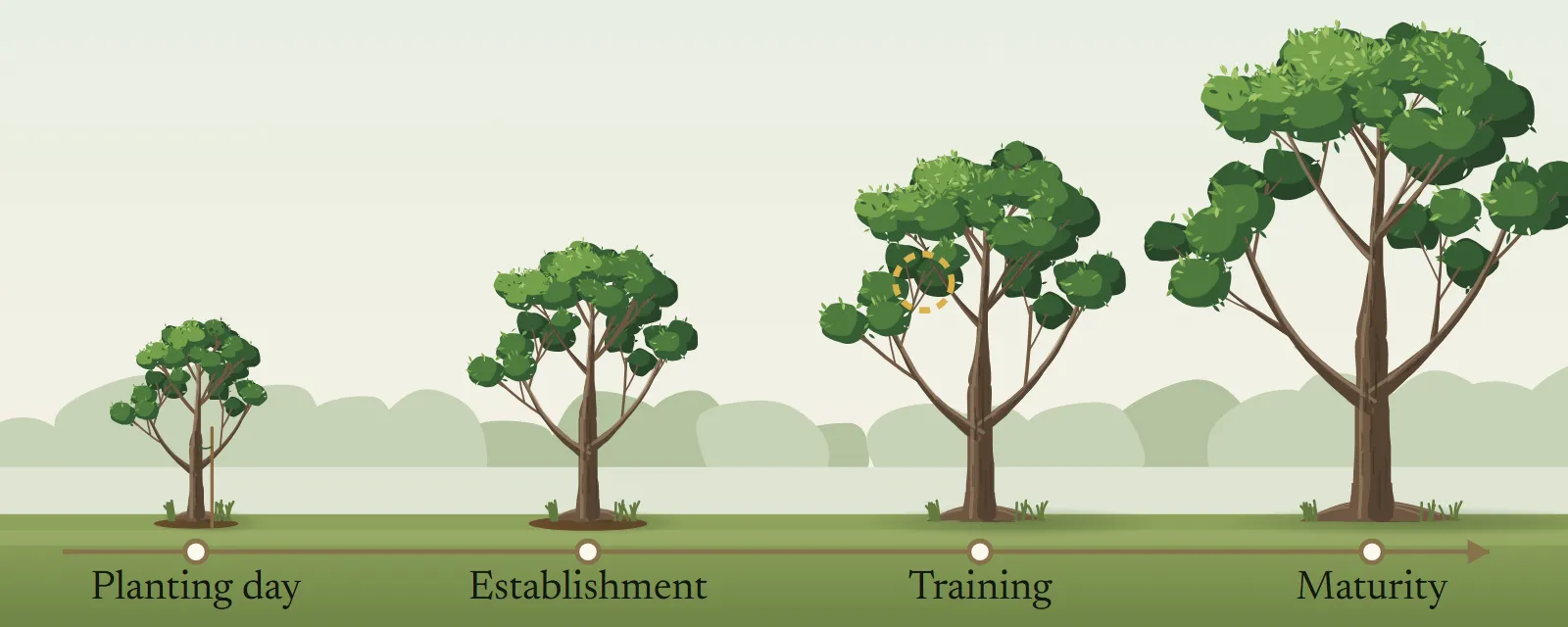
A new site is hard on young trees: soil packed down by construction, big root balls, and summer heat. Here is how a planting program carries them from install to maturity.
- 1
Plan and specify
Species suited to each spot at mature size, spaced clear of buildings, pavement, and power lines. On compacted construction soil, University of Arkansas Extension recommends planting holes three to four times the root ball’s width.
- 2
Plant, or check the planting
Root flare at or just above grade, burlap and the top of any wire basket removed, circling roots cut, and mulch no deeper than 3 inches, kept off the trunk.
- 3
Establish
Watering is the most critical factor after planting. Larger trees take longer to establish, and establishment takes longer in cooler climates, so the plan follows the trees, not the calendar.
- 4
Train
Stakes only where needed, with ties checked so they don’t girdle the trunk, and a structural pruning program that UF/IFAS recommends carrying out regularly for the first fifteen to twenty years.
- 5
Grow and monitor
AIM baselines at planting and re-checks as the trees grow, so problems are caught early and replacements are planned, not rushed.
Every tree on the map
A record for each tree, from day one.
Each tree is mapped in ArborNote with its species and location, and every visit adds a work order with before-and-after photos. When a site changes hands, from builder to owner or to an HOA, the history goes with it.
Sources: University of Arkansas Extension, Planting a Tree or Shrub (FSA6128); UF/IFAS, Planting and Establishing Trees and Gilman, Irrigating Landscape Plants During Establishment (ENH857).
The same eight services
Everything your grounds might need.
Whoever the client, the care is the same: careful, science-based, and explained in plain English.


How we think through a tree problem
Care built around the tree,
not a sales quota.
We don’t arrive with a work order already in mind. Each visit follows the same careful sequence, so recommendations come from evidence—and sometimes the right answer is to wait and watch.
-
01
Observe
What changed, where on the tree, and since when?
-
02
Site & history
Construction, grading, irrigation, weather, and past work.
-
03
Soil & root zone
Compaction, drainage, root flare, and disturbance.
-
04
Canopy & structure
Growth, dieback, and branch architecture.
-
05
Pests & disease
Signs identified in context—never assumed.
-
06
Recommendation
The right work for this tree—or none at all.

Let’s start with a conversation
Your trees have a story.
We’re here to listen.
Tell us what you’re noticing. We’ll help you understand it—and decide what, if anything, should happen next. We reply to every request the same day.
Have photos or a video of the tree? Text them to (870) 340-2074.
- Jonesboro and Northeast Arkansas (NEA), Memphis, Little Rock, Bentonville, and surrounding areas
- Licensed, bonded & insured