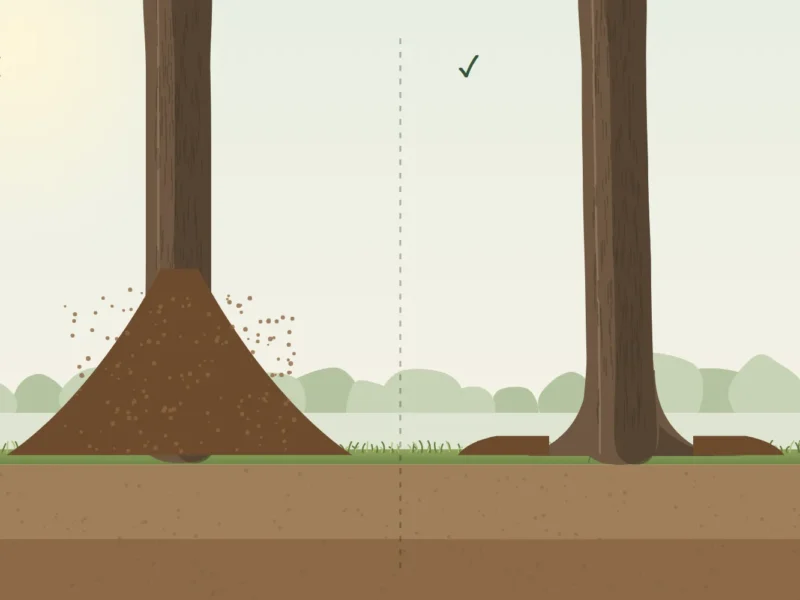
Mulch volcanoes and buried root flares: two fixes most trees need
A tree should look like it’s standing on its roots, not planted like a fence post. Here’s how to spot a mulch…

A tree health assessment is an on-site look at a tree that’s changing, to understand what’s happening and what, if anything, to do next.
When a tree changes, the useful question is not only “what is it?” It is also “why here, and why now?”
Common requests

The Magnolia approach
Observations, history, and growing conditions work together. An assessment helps define what is known, what needs investigation, and what comes next.
When did the change begin? Is it seasonal, sudden, or gradually progressing?
Consider the canopy, branches, trunk, root flare, and visible signs together.
Plant Health CareLook at drainage, soil disturbance, water availability, and changes around the tree.
Plant Health CareDefine practical recommendations, monitoring, or further investigation.
Tree CareAn assessment can become the start of an AIM baseline: standard photos and measurements, recorded so a later visit can be compared with this one. How AIM works
Start before we arrive
Photos or a short video help us understand what you’re seeing and come prepared. They don’t replace an on-site look, but they’re a great first step.
Text us photos or videos of your tree
How we think through a tree problem
We don’t arrive with a work order already in mind. Each visit follows the same careful sequence, so recommendations come from evidence—and sometimes the right answer is to wait and watch.
What changed, where on the tree, and since when?
Construction, grading, irrigation, weather, and past work.
Compaction, drainage, root flare, and disturbance.
Growth, dieback, and branch architecture.
Signs identified in context—never assumed.
The right work for this tree—or none at all.
Start with what you see
A symptom is a clue, not a conclusion. Choose what you’ve noticed to see what might be involved—and why a closer look matters.
If you’re seeing
Leaf color alone rarely identifies the cause.
Possible contributors
If you’re seeing
A pattern that often develops over several seasons.
Possible contributors
If you’re seeing
Where the dieback appears is an important clue.
Possible contributors
If you’re seeing
Hole shape, size, and location narrow the possibilities.
Possible contributors
If you’re seeing
Fungal fruiting bodies can indicate decay—or nothing serious.
Possible contributors
If you’re seeing
Some bark changes are completely normal growth.
Possible contributors
If you’re seeing
Many leaf spots are cosmetic; some are not.
Possible contributors
If you’re seeing
Timing and which leaves drop first both matter.
Possible contributors
General education only. Several causes can look alike; identifying what is affecting a specific tree requires an on-site assessment.
How pricing works
Every tree and every site is different, so we don’t post prices. We look at the trees, talk through what you want, and put the scope and price in writing. Work begins only after you’ve agreed to it.
Your trees, your site, and what you’d like to change.
Which trees, what work, and what it costs.
Nothing starts until the scope and price are settled.
We map your trees in ArborNote and email you a clear work order on every job. See how transparent tree care works
Tell us what changed, when you first noticed it, and whether there has been nearby construction, digging, irrigation change, or other site work.
They have different objectives. Tree health concerns growth and condition; tree risk also considers failure and what could be affected. Tell us your concern so the scope can be discussed.
Some cases need testing, specialist input, or observation over time. Any uncertainty should remain clear in the recommendations.
Keep reading
A tree should look like it’s standing on its roots, not planted like a fence post. Here’s how to spot a mulch…
Continue exploring
Let’s start with a conversation
Tell us what you’re noticing. We’ll help you understand it—and decide what, if anything, should happen next. We reply to every request the same day.
Have photos or a video of the tree? Text them to (870) 340-2074.


