Nesting
Red-bellied Woodpecker
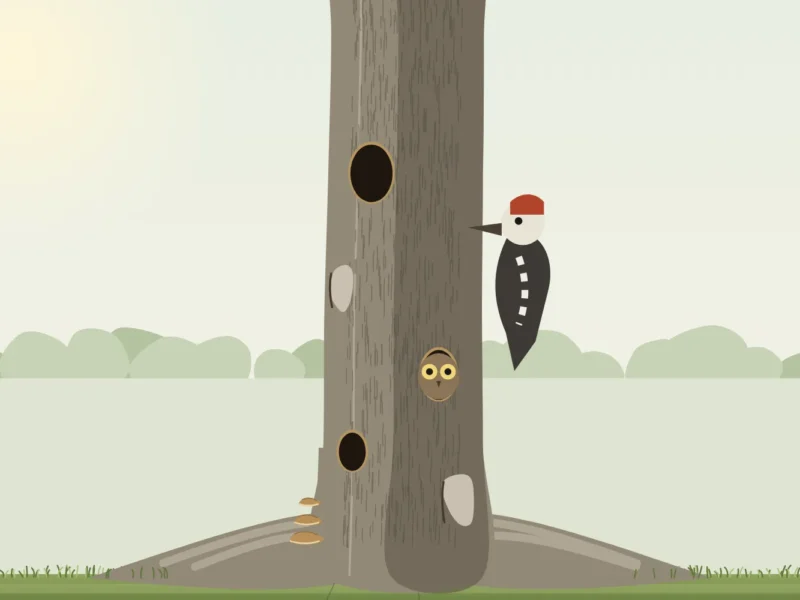
Nests in dead trees and dead limbs of live trees, and usually digs a fresh cavity each year.
Source: Cornell Lab of Ornithology, All About Birds: Red-bellied Woodpecker

A wildlife habitat tree, or snag, is a hazardous tree that’s cut down to a shorter, lower-risk trunk and left standing for birds and other wildlife.
When a tree has to come down and is a good candidate, it doesn’t always have to go all the way. A shorter, carefully shaped trunk can keep giving back to wildlife.
Common requests

The Magnolia approach
This is only an option when a tree needs to be removed and is judged a good candidate. The goal is a lower-risk trunk that keeps its place in the ecosystem.
We only consider a snag when the tree needs to be removed and the tree and site suit it.
The crown and limbs come down, leaving a shorter trunk with far less to fall.
We use coronet cuts so the top looks like a natural break rather than a flat saw cut.
We cut one or two nest cavities—bird houses built into the trunk itself.
We inspect the snag every year to make sure it stays low risk.
If it ever becomes a hazard, we remove whatever remains.
Tree RemovalRecommendations may be informed by AIM, our system of baselines, measurements, and records kept over time. How AIM works
Why dead trees matter
A snag is a standing dead or dying tree. Woodpeckers dig nest holes in its wood. When they move on, those holes become homes for birds and mammals that can’t dig their own. Insects and fungi slowly break the wood down, and become food in turn.
Most dead trees near homes simply need to come down. But when a tree needs to be removed and is a good candidate, a carefully made snag lets it keep that role.
IllustrationWildlife habitat tree
Drag to compare a declining tree that needs to come down with the lower-risk snag it can become: a shorter trunk, a natural-looking top, and nest cavities.
Who lives here?
Wildlife in Arkansas that use dead trees and tree cavities. Choose an animal to see how it uses a snag. Each fact comes from the Cornell Lab of Ornithology, the USDA Forest Service, or the Arkansas Game & Fish Commission.
Nesting
Nests in dead trees and dead limbs of live trees, and usually digs a fresh cavity each year.
Source: Cornell Lab of Ornithology, All About Birds: Red-bellied Woodpecker
Nesting
Nests in dead trees or dead parts of live trees, often in snags that have lost most of their bark.
Source: Cornell Lab of Ornithology, All About Birds: Red-headed Woodpecker
Nesting · Foraging
Its nest tree is typically dead. It feeds mainly on carpenter ants, plus wood-boring beetle larvae and termites.
Source: Cornell Lab of Ornithology, All About Birds: Pileated Woodpecker
Nesting
Digs its nest in dead trees or dead parts of live trees, often where a fungus has softened the wood.
Source: Cornell Lab of Ornithology, All About Birds: Downy Woodpecker
Nesting
Digs a cavity or finds an unused one, usually 2–25 feet up in a tree.
Source: Cornell Lab of Ornithology, All About Birds: Carolina Chickadee
Nesting
Typically nests in natural tree cavities or old woodpecker holes.
Source: Cornell Lab of Ornithology, All About Birds: White-breasted Nuthatch
Nesting · Roosting
Nests in natural cavities and old woodpecker holes. It never digs its own.
Source: USDA Forest Service, Fire Effects Information System: Eastern screech-owl
Nesting
Usually nests in a natural cavity 20–40 feet up in a large tree.
Source: Cornell Lab of Ornithology, All About Birds: Barred Owl
Nesting
Often chooses an old woodpecker hole in a dead pine or oak.
Source: Cornell Lab of Ornithology, All About Birds: Eastern Bluebird
Nesting
Can’t make its own cavity. It nests in tree cavities, usually near or over water.
Source: Cornell Lab of Ornithology, All About Birds: Wood Duck
Nesting
Nests in old woodpecker and chickadee holes and natural holes in standing dead trees, often over water.
Source: Cornell Lab of Ornithology, All About Birds: Prothonotary Warbler
Roosting
In Arkansas’s Ouachita Mountains, every roost researchers found was in a shortleaf pine snag, mostly under loose bark.
Source: USDA Forest Service: Perry & Thill (2008), roost selection by big brown bats in forests of Arkansas
Denning
Old woodpecker holes make ideal homes. In winter a dozen or more may share one cavity.
Source: Arkansas Game & Fish Commission: Arkansas’s most secretive squirrel (2024)
Food for woodpeckers
Carpenter ants, wood-boring beetle larvae, and termites are the Pileated Woodpecker’s main food.
Source: Cornell Lab of Ornithology, All About Birds: Pileated Woodpecker
The recyclers
Fungi soften dead wood, which makes it easier for woodpeckers to dig their nests.
Source: Cornell Lab of Ornithology, All About Birds: Downy Woodpecker
Illustrations, simplified for clarity. Wildlife use varies by region, season, and the individual tree.
An honest fit check
Suitability always depends on the tree and the site. Often, full removal is the right call.
We recommend a comprehensive approach to ongoing monitoring and reporting for every habitat tree. Ask us how it would work for your property.
General education. Wildlife use varies by region, season, and the individual tree.
How pricing works
Every tree and every site is different, so we don’t post prices. We look at the trees, talk through what you want, and put the scope and price in writing. Work begins only after you’ve agreed to it.
Your trees, your site, and what you’d like to change.
Which trees, what work, and what it costs.
Nothing starts until the scope and price are settled.
We map your trees in ArborNote and email you a clear work order on every job. See how transparent tree care works
No. A snag reduces the hazard; it does not eliminate it. Dead wood keeps changing, which is why we inspect it every year and remove what remains if it becomes a hazard.
No. Suitability depends on the tree’s condition and species and on what’s nearby: buildings, roads, play areas, utilities, and any local rules. Many trees are better removed completely.
We recommend a comprehensive approach to ongoing monitoring and reporting for every habitat tree. Ask us how it would work for your property.
Keep reading
When a tree has to come down, it doesn’t always have to go all the way. Here’s how a carefully made snag…
Continue exploring
Let’s start with a conversation
Tell us what you’re noticing. We’ll help you understand it—and decide what, if anything, should happen next. We reply to every request the same day.
Have photos or a video of the tree? Text them to (870) 340-2074.