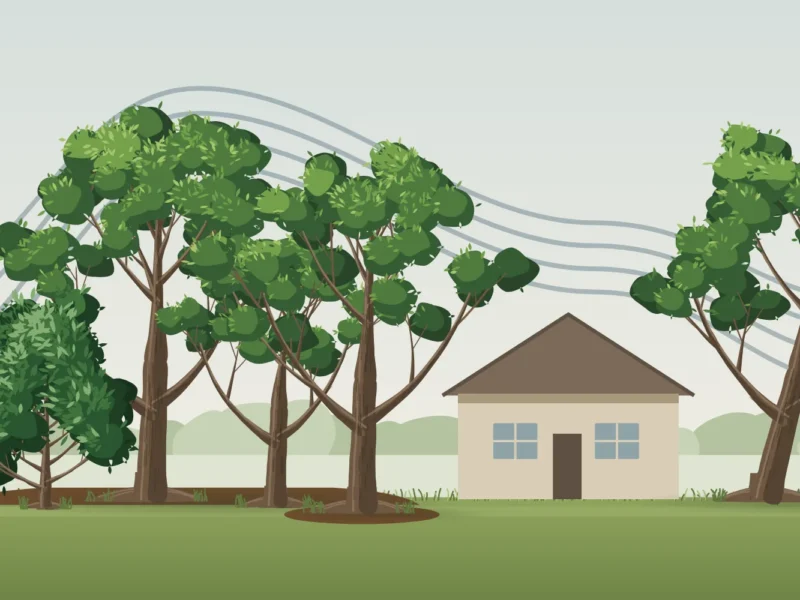
Strength in numbers: why trees in groups stand up to storms better than trees alone
Hurricane and wind research finds that trees growing in groups fail less often than trees standing alone. What that means for planting…

Tree planting is choosing a tree that suits your site and planting it so it can establish: at the right depth, with its roots freed, mulched, and watered until it takes hold.
A new tree is a long-term investment. Choosing a species that suits the site, planting it at the right depth, and watering it well while its roots establish set it up for decades of growth.
Common requests

The Magnolia approach
Most new-tree problems start on planting day. We follow University of Arkansas Extension guidance, from checking the site to watering afterward.
Sun, soil, drainage, and room to grow. Underground utilities are marked through 811 before anyone digs.
A species that fits the space at its mature size, stays well clear of power lines, and, if you like, feeds birds and pollinators.
The root flare sits at or just above the finished grade. The hole is wide, not deep: one and a half to two times the root ball’s width, and wider in compacted soil.
Burlap and rope come off the top of the root ball, the top of any wire basket is cut away, and circling roots are sliced so new roots grow outward.
A ring of mulch no more than 3 inches deep, kept off the trunk, and a watering plan: the most important step after planting, light and frequent at first, adjusted for rain and soil.
Stakes only when they’re truly needed, and structural pruning in the early years for a strong framework.
Tree CareRecommendations may be informed by AIM, our system of baselines, measurements, and records kept over time. How AIM works
Educational exampleTree planting
Drag to compare an open lawn with the same yard a few seasons after planting: Southern magnolias for evergreen shade, native shrubs with berries for birds, and a bed of flowers for butterflies and bees.
Before you plant
A tree that fits its spot at full size needs far less work later. A little planning now saves a lot of pruning, and sometimes a removal, down the road.
University of Arkansas Extension advises never planting a tree that grows taller than 15 feet beneath power lines or within 15 feet of them, and ideally keeping trees as far from the lines as their mature spread. Allow for roots near foundations, walks, and drives, too.
Well-placed trees shade a home and are associated with higher home values. See the research.
Native trees, shrubs, and flowers for birds and pollinators, chosen for your part of our service area.
Planting for Wildlife guideFor new communities and commercial sites: every tree mapped and cared for from planting day to maturity.
New Development Tree CarePlanting guidance from University of Arkansas Extension, Planting a Tree or Shrub (FSA6128), and Fall Tree Care and Planting Tips.
How pricing works
Every tree and every site is different, so we don’t post prices. We look at the trees, talk through what you want, and put the scope and price in writing. Work begins only after you’ve agreed to it.
Your trees, your site, and what you’d like to change.
Which trees, what work, and what it costs.
Nothing starts until the scope and price are settled.
We map your trees in ArborNote and email you a clear work order on every job. See how transparent tree care works
In Arkansas, fall is a great time to plant trees and shrubs. Planting in late fall, while trees are dormant, gives the roots time to grow before they have to supply new leaves. Other times can work with closer attention to watering.
It depends on the tree’s size, the soil, and the weather. As one example from University of Arkansas Extension, a tree with a 2-inch trunk may need about 4 gallons over the root ball each time it’s watered, which in summer can mean several times a week. Too much water can harm a tree as surely as too little.
Usually not. University of Arkansas Extension notes that fertilizer at planting hasn’t been shown to improve survival, and that amending the backfill isn’t needed except in very poor soil. A soil test is a better first step.
Yes. Our Planting for Wildlife guide lists native trees, shrubs, and flowers for each part of our service area, with what each one offers wildlife.
University of Arkansas Extension considers Bradford (Callery) pear invasive in Arkansas: it spreads aggressively and crowds out native plants. Native flowering trees such as redbud, dogwood, and serviceberry are better choices.
Keep reading
Hurricane and wind research finds that trees growing in groups fail less often than trees standing alone. What that means for planting…
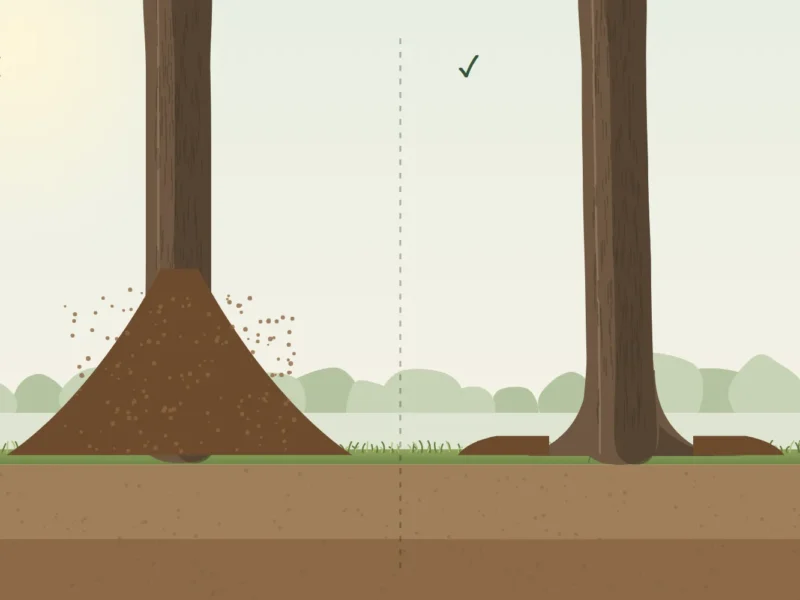
A tree should look like it’s standing on its roots, not planted like a fence post. Here’s how to spot a mulch…
Continue exploring
Let’s start with a conversation
Tell us what you’re noticing. We’ll help you understand it—and decide what, if anything, should happen next. We reply to every request the same day.
Have photos or a video of the tree? Text them to (870) 340-2074.