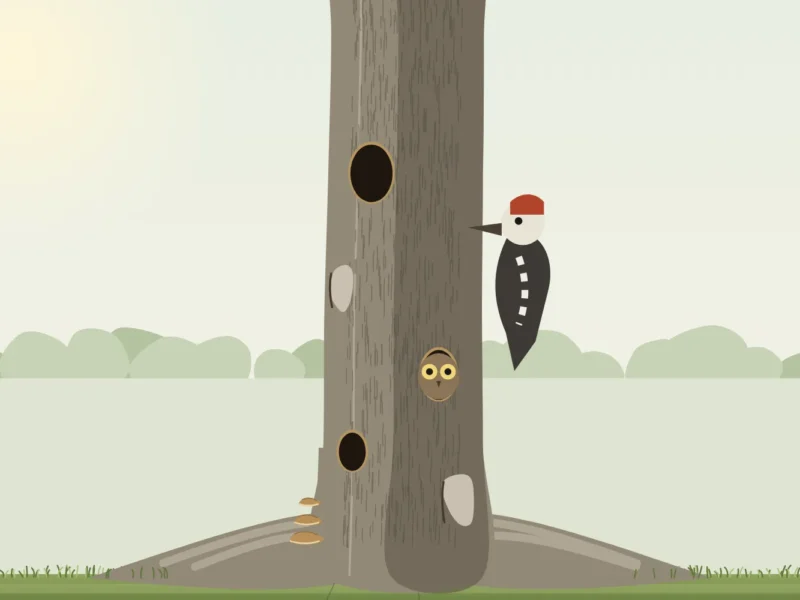
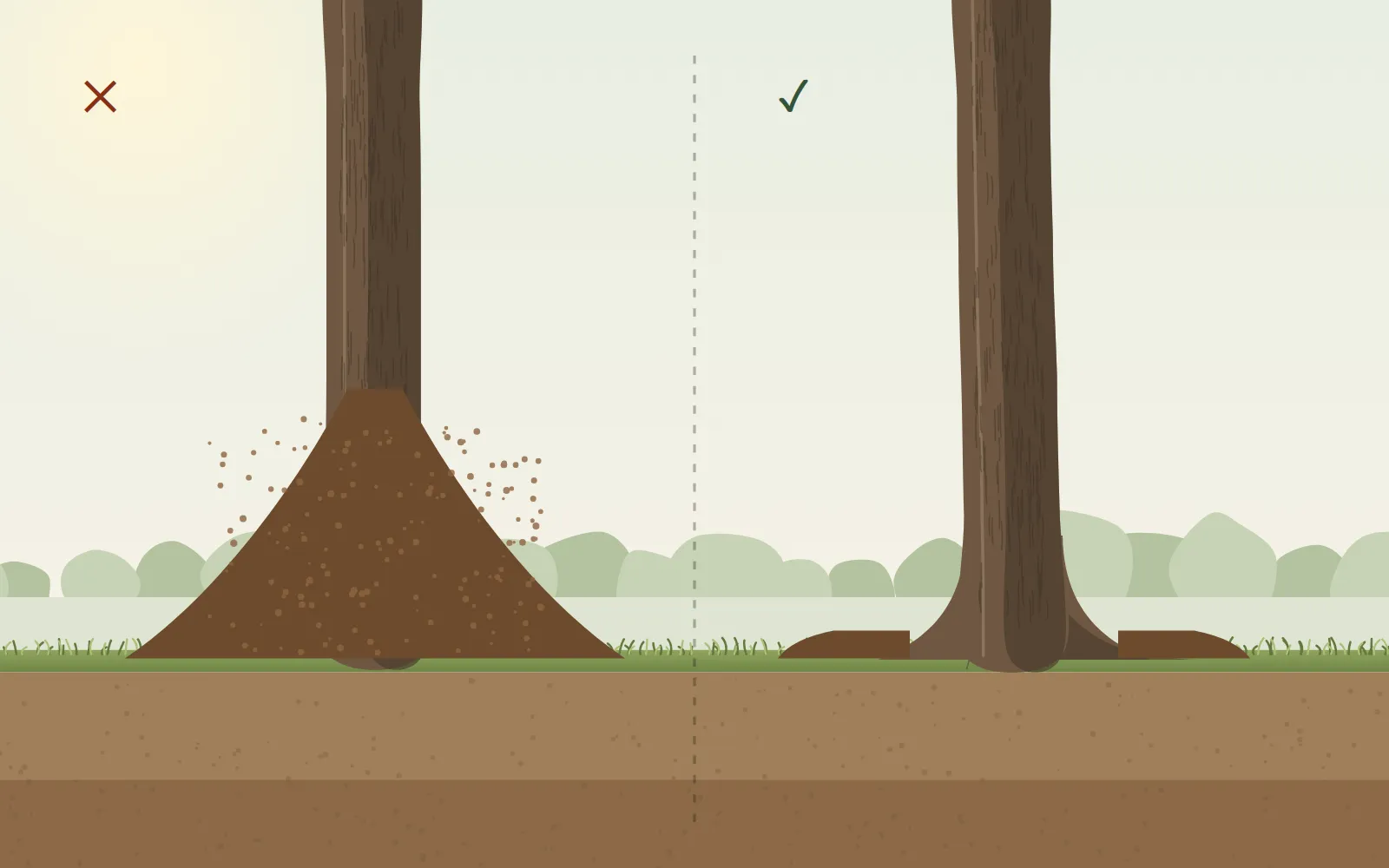
Look at the base of the trees in your yard. Does each trunk widen where it meets the ground, like the flared base of a candlestick? Or does it go straight into the soil, or into a mound of mulch, like a fence post?
That widening is the root flare (also called the trunk flare or root collar). Whether you can see it is one of the simplest and most useful checks you can make on a tree. Two very common problems hide it: mulch volcanoes and buried flares. Both are easy to create, and both can be fixed.
What the root flare is, and why it should show
The root flare is where the trunk transitions into the major roots. Trunk bark is built to be exposed to air. When soil or mulch is piled against it and stays damp, the bark can soften and decay, and insects, fungi, and rodents find it easier to get in.
A tree growing naturally shows its flare at the soil surface. If you can’t see it, something is covering it.
Problem 1: mulch volcanoes
A mulch volcano is a cone of mulch piled high against the trunk. It’s everywhere, in yards, parking lots, and commercial landscapes. It looks tidy, and it’s often refreshed by adding another layer every year, so the pile grows.
Why it’s a problem:
- It holds moisture against the bark, inviting decay and disease at the base of the trunk.
- It can shelter rodents and insects that chew or bore into the bark.
- Roots may grow up into the mulch and begin circling the trunk. Over years, these can become girdling roots that squeeze the trunk.
- Thick layers can shed water, so rain runs off the mound instead of reaching the roots below.
Mulch done right
Mulch itself is great for trees. In Arkansas’s hot summers and often-clay soils, a good mulch layer helps the soil hold moisture, moderates soil temperature, adds organic matter as it breaks down, and keeps mowers and string trimmers away from the trunk.
Good mulching looks like a wide, flat donut, not a volcano:
- 2 to 4 inches deep. Deeper isn’t better.
- As wide as practical. Out toward the edge of the canopy (the dripline) if you can, since most of a tree’s absorbing roots are spread wide and shallow.
- Pulled back a few inches from the trunk, so the flare stays visible and the bark stays dry.
- An organic material, such as wood chips or shredded bark.
Mulch breaks down over time, so top it up as needed. Rake out the old layer first rather than piling more on top.
How to fix a mulch volcano
For most mulch volcanoes this is a simple job:
- Gently pull the mulch away from the trunk with your hands or a rake, working carefully so you don’t scrape the bark.
- Spread it out into a wide, even layer, 2 to 4 inches deep.
- Look at the base of the trunk. If you can now see the flare, you’re done.
- If there’s still no flare, or you see roots circling the trunk, the flare may be buried deeper (see below).
Problem 2: buried root flares
Sometimes the flare is buried by soil rather than mulch. This commonly happens when:
- A tree was planted too deep, often because the root ball was set low or the nursery soil already covered the flare.
- Soil was added during construction, landscaping, or regrading, even just a few inches.
- Beds were built up around an existing tree.
The effects build slowly. Bark kept damp can decay. Roots can grow in the wrong direction and girdle the trunk. A tree with a buried flare may decline for reasons that aren’t obvious from the canopy alone.
How to check, and what an arborist can do
Clue: a trunk that goes straight into the ground with no widening. Another clue is a tree that seems to be struggling for no clear reason.
Checking a deeply buried flare is a job for an arborist. The process is called a root collar excavation. Soil is carefully removed from around the base of the trunk, often with air tools that move soil without cutting roots, to find the true flare and look for girdling or damaged roots. Depending on what’s found, the arborist can remove the excess soil, recommend treating any girdling roots, and help set up a proper mulch layer.
This is careful work. Digging aggressively with a shovel can injure the very roots you’re trying to protect.
A quick yard check
Walk your property with these three questions:
- Can I see a flare at the base of every tree?
- Is mulch touching the bark, or piled higher than a few inches?
- Has soil been added around any tree since it was planted?
If a tree fails any of these, it’s worth fixing, and in most cases the fix is simple.
General education only. Every tree, species, and site is different, and this article is not advice about a specific tree.
Want a closer look at a tree’s base and roots? Learn about Plant Health Care, or call or text us to talk it through.