Most of the time, when a tree needs to be removed, the answer is simple: take it down safely and clean up. But every so often we meet a tree that needs to go and could still do some good standing, as long as it’s made much safer first.
In those cases, we sometimes recommend turning it into a wildlife snag: a shorter, carefully shaped trunk left standing for birds and other animals. Here’s what that means, why it matters, and why it isn’t the right answer for every tree.
What is a snag?
A snag is simply a standing dead or dying tree. That’s how NC State Extension defines it, and it notes that in the southeastern United States, more than 45 species of birds and more than 20 species of mammals use snags for nesting, roosting, foraging, perching, or territorial displays.
To a tree owner, a dead tree can look like nothing but a problem. To wildlife, it can be one of the most useful structures in the landscape.
Why dead wood matters
Dead and dying wood is where a lot of life happens.
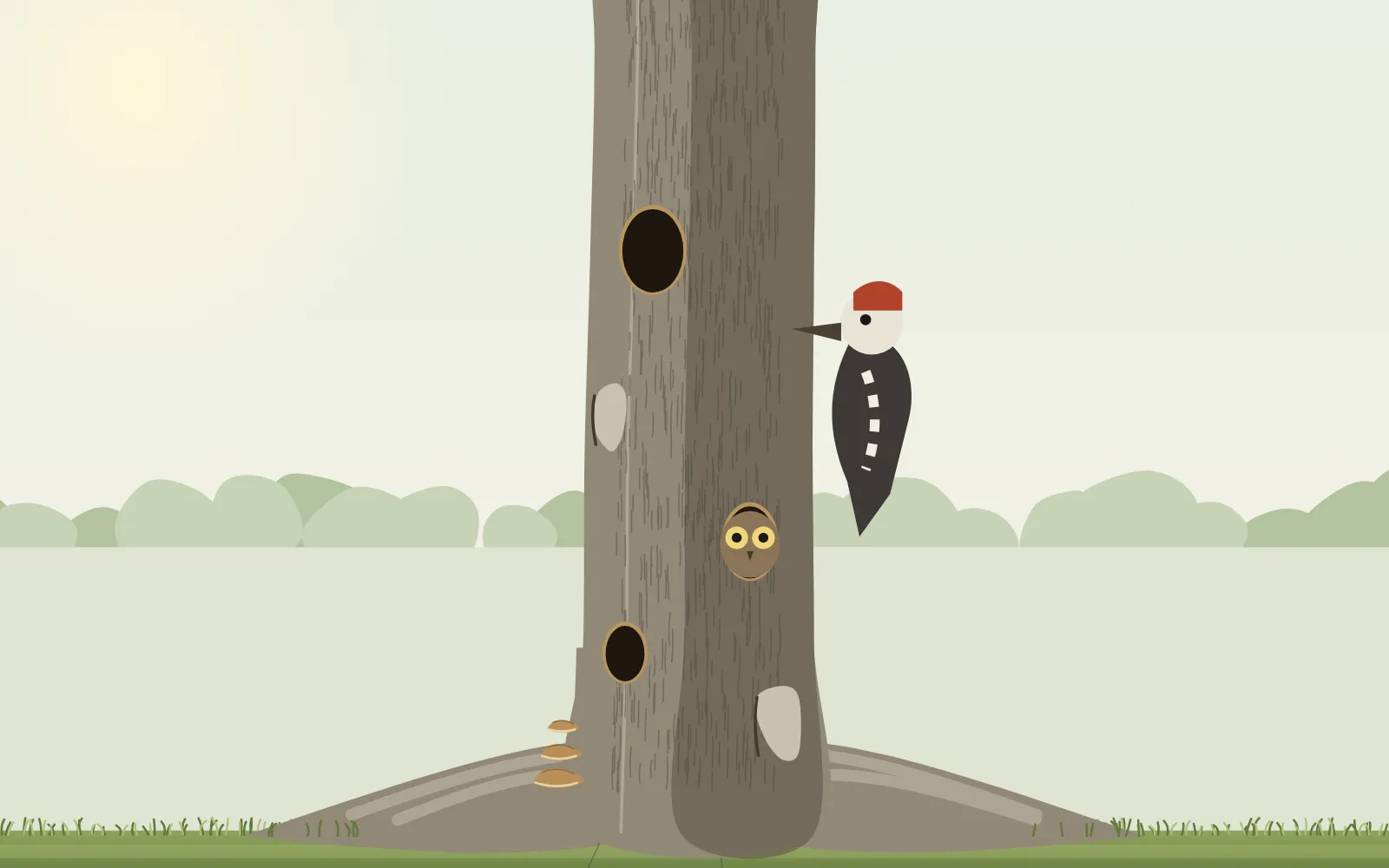
Woodpeckers are the builders. Many woodpeckers dig their nest holes in dead wood. The Cornell Lab of Ornithology notes that Red-bellied Woodpeckers nest in dead trees and in dead limbs of live trees, and usually excavate a new cavity each year. Downy Woodpeckers nest in dead trees or dead parts of live trees, often where a fungus has softened the wood.
Other animals move in after them. Many animals can’t dig a cavity of their own. They depend on the holes that woodpeckers, decay, and broken branches leave behind. According to the Cornell Lab:
- White-breasted Nuthatches typically nest in natural tree cavities or abandoned woodpecker holes.
- Eastern Screech-Owls nest in cavities but never dig their own, relying on holes opened by woodpeckers, fungus, rot, or squirrels.
- Eastern Bluebirds often choose old woodpecker holes in dead pine or oak trees.
- Wood Ducks can’t make their own cavities, and nest in tree cavities, usually near or over water.
Birds aren’t the only tenants. University of Florida IFAS Extension lists southern flying squirrels and many kinds of bats among the animals that use tree cavities.
Insects and fungi are the recyclers. Penn State Extension notes that snags are a common source of insects and other invertebrates, a food supply that may be especially important for birds in winter. Fungi slowly break the wood down, and in doing so make it easier for woodpeckers to excavate.
Put simply, a dead tree isn’t dead to everything around it.
So why not leave every dead tree standing?
Because a dead tree can also be dangerous. Dead wood weakens as it decays, dead limbs can fall, and a large dead crown carries a lot of weight above whatever is underneath it.
Near a house, a driveway, a sidewalk, or a swing set, that risk usually outweighs the benefit. That’s why most dead trees near homes and gathering spaces simply need to be removed.
A wildlife snag is a middle path for the right tree in the right place: reduce the hazard, and keep the habitat.
How we turn a hazardous tree into a snag
This is only an option when a tree needs to be removed and is judged a good candidate. When it is, here’s our approach:
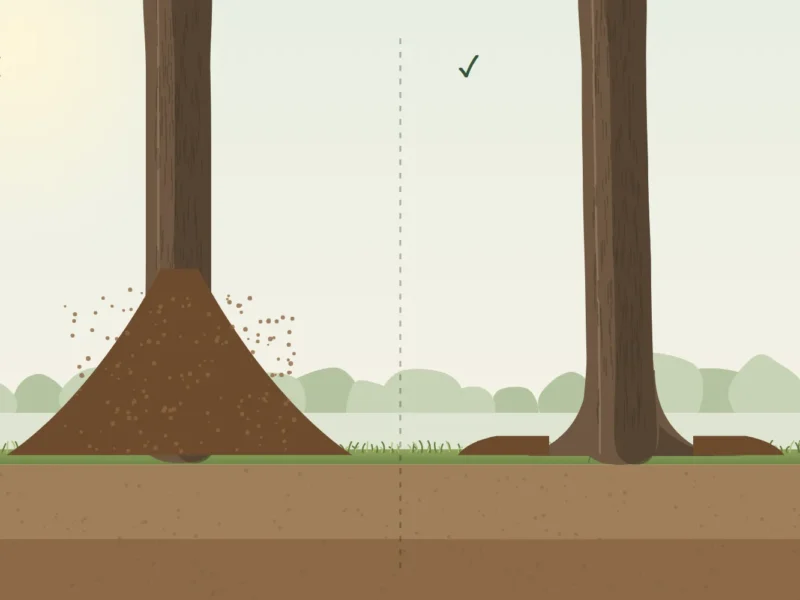
- Reduce the hazard. We remove the crown and limbs, leaving a much shorter trunk with far less to fall.
- Make the top look natural. We use coronet cuts, which leave an irregular top that looks like a natural break instead of a flat saw cut.
- Add room to nest. We cut one or two nest cavities into the trunk, like bird houses built into the tree itself.
- Inspect it every year. A snag keeps changing as it decays, so we inspect it every year to make sure it stays low risk.
- Remove it if it becomes a hazard. If it ever does become a hazard, we remove whatever remains.
The result is a trunk that can keep its role in the ecosystem, with much less of the risk that made removal necessary in the first place.
When a snag isn’t the right choice
Suitability always depends on the tree and the site. A snag usually isn’t appropriate:
- close to a house or other building
- near roads, driveways, or walkways
- near play areas, or anywhere people regularly gather
- when the tree’s condition or species makes it unsuitable
- near utility lines
- where local rules or community guidelines don’t allow it
University of Florida IFAS Extension makes the same point: a snag left standing must not become a risk to structures or property.
Honest limits
We want to be clear about what a snag can and can’t do.
- A snag reduces the hazard. It doesn’t eliminate it.
- There are no guarantees. Dead wood keeps changing over time.
- That’s exactly why the yearly inspection matters, and why we’ll remove whatever remains if the snag ever becomes a hazard.
For every habitat tree, we recommend a comprehensive approach to ongoing monitoring and reporting. Ask us how that would work for your property.
Is your tree a candidate?
If you have a dead or dying tree that needs attention, start with an evaluation. We’ll look at the tree, what’s around it, and what you’d like for the space. Sometimes the answer is full removal. Sometimes it’s a snag. Either way, the scope and price are agreed in writing before any work begins.
General education only. This article doesn’t replace an on-site evaluation. If a tree or limb is an immediate danger, keep people away, and in an emergency call 911.
Wondering whether a tree could become a wildlife snag? Learn about Wildlife Habitat Trees, or call or text us with photos of the tree.