Professional PruningPruning with the future in mind.

Professional pruning—often called tree trimming—is the selective removal of branches for structure, clearance, and health.

Thoughtful pruning balances the needs of a living tree with the space around it. It begins with a clear objective.

Common requests

  • Tree trimming
  • Dead limb removal
  • Clearance over a roof or driveway
  • Raising low branches over a walk
  • Structural pruning for young trees

Serving Jonesboro and Northeast Arkansas (NEA), Memphis, Little Rock, Bentonville, and surrounding areasISA Board Certified Master Arborist®

Illustration: a well-shaped tree with fresh pruning cuts circled at the branch collars and a pole pruner
Every cut has a purpose

The Magnolia approach

A plan before the first cut.

The amount, timing, and type of pruning depend on the tree. A smaller, purposeful intervention can be more appropriate than a dramatic change.

Structure

Assess competing or poorly positioned branches with long-term development in mind.

Clearance

Create appropriate space around buildings and routes while considering tree form.

Dead branches

Evaluate deadwood and its relationship to the occupied space below.

Tree Risk & Consulting

Young trees

Guide early growth through a measured sequence of small decisions.

Tree Care

Recommendations may be informed by AIM, our system of baselines, measurements, and records kept over time. How AIM works

Good pruning ≠ just cutting branches

See beyond the cut.

Most people never see what separates professional tree care from a quick job. These are the details that decide how a tree grows—and how long it lives.

Pruning cutsWhere a cut is made matters as much as which branch.

Flush cut: removes the collarStub: can’t close over✕ Common mistake
  • Flush cuts remove the branch collar—the tissue that helps a tree seal off a wound.
  • Stubs are left to die back, inviting decay into the trunk.
Cut just outside the collarBranch bark ridgeBranch collar stays intact✓ Proper practice
  • Cut just outside the branch collar and branch bark ridge.
  • Remove larger limbs in three cuts so bark doesn’t tear.
  • Trees don’t “heal”—they wall off wounds and grow woundwood over them. Wound paint is generally unnecessary.
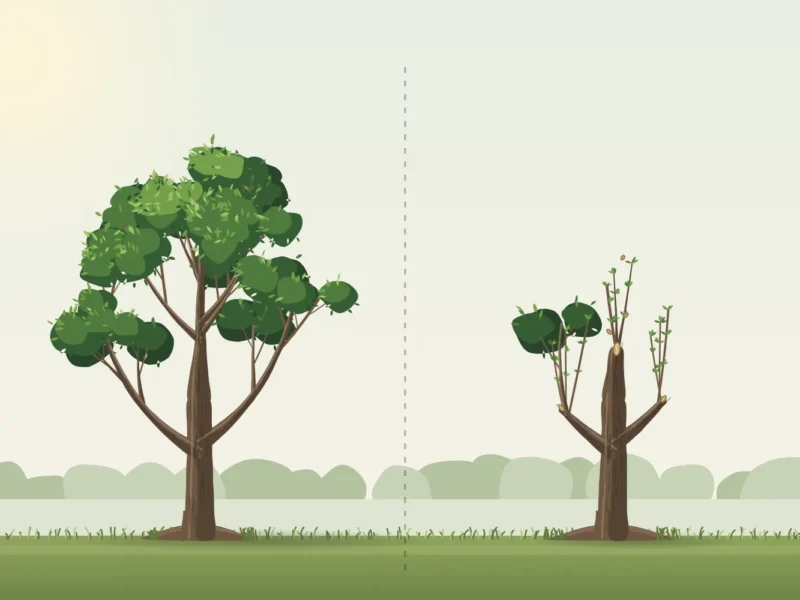
Topping vs. reductionTopping isn’t a size fix. Reduction is.

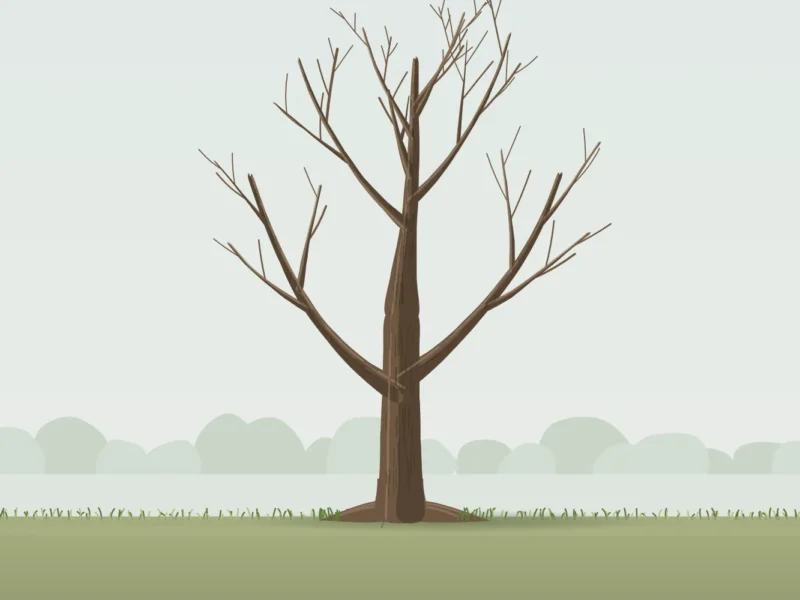
Topping: stubs decay; weak sprouts regrow fast✕ Common mistake
  • Topping cuts main stems to stubs at an arbitrary height.
  • It triggers dense, weakly attached sprouts and decay—often making a tree more hazardous, not less.
Reduction: cut back to a strong lateral branchOriginal size✓ Proper practice
  • Reduction shortens a stem back to a lateral branch large enough to take over (industry guidance: at least one-third the diameter of the stem removed).
  • Fewer, well-placed cuts keep the tree’s natural form.

General education based on widely published arboricultural practice. The right approach for a specific tree depends on its species, condition, and site.

Educational exampleStructural pruning

Small decisions. Lasting direction.

A healthy tree in full leaf with five common structural problems. Drag to compare them with the selective cuts that correct them, each made just outside the branch collar, while the tree keeps its natural form.

BeforeFive structural problemsEducational illustration — Five structural problems.3Deadwood4Water sprouts1Codominant stems, included bark2Crossing & rubbing5Low limb over the walk34125
AfterOnly those five things changedEducational illustration — Only those five things changed.3Deadwood removed1Rival stem reduced: one leader4Water sprouts removed2Crossing branch removed5Low limb removed: walk clear31425
  1. Before: Codominant stems, included barkAfter: Rival stem reduced: one leader
  2. Before: Crossing & rubbingAfter: Crossing branch removed
  3. Before: DeadwoodAfter: Deadwood removed
  4. Before: Water sproutsAfter: Water sprouts removed
  5. Before: Low limb over the walkAfter: Low limb removed: walk clear
Drag the handle—or use arrow keys—to compare. Educational example, not a Magnolia project. Results vary by tree, site, condition, and management approach.

How pricing works

Agreed in writing before work begins.

Every tree and every site is different, so we don’t post prices. We look at the trees, talk through what you want, and put the scope and price in writing. Work begins only after you’ve agreed to it.

  1. 01
    We look and listen

    Your trees, your site, and what you’d like to change.

  2. 02
    A written scope and price

    Which trees, what work, and what it costs.

  3. 03
    Work begins when you agree

    Nothing starts until the scope and price are settled.

We map your trees in ArborNote and email you a clear work order on every job. See how transparent tree care works

A little more clarity

Common questions.

Ask about your tree
When is the right time to prune?

Timing depends on species, the purpose of the work, tree condition, and local pest or disease considerations. Discuss those factors before scheduling.

Can pruning make a tree completely safe?

No. Pruning may be one management option, but no tree work can eliminate all risk.

Will you remove every crossing branch?

Not automatically. The size, position, condition, and consequences of removing a branch all matter.

Let’s start with a conversation

Your trees have a story.
We’re here to listen.

Tell us what you’re noticing. We’ll help you understand it—and decide what, if anything, should happen next. We reply to every request the same day.

Have photos or a video of the tree? Text them to (870) 340-2074.

  • Jonesboro and Northeast Arkansas (NEA), Memphis, Little Rock, Bentonville, and surrounding areas
  • Licensed, bonded & insured