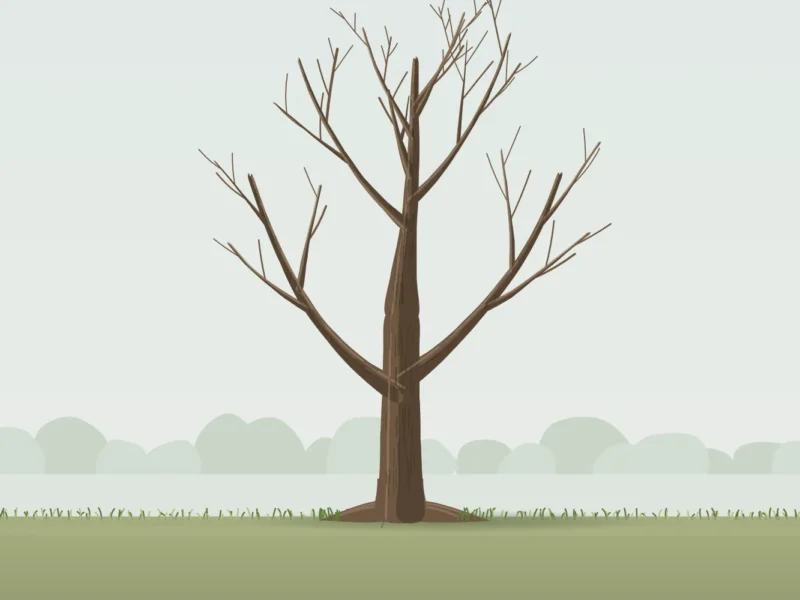
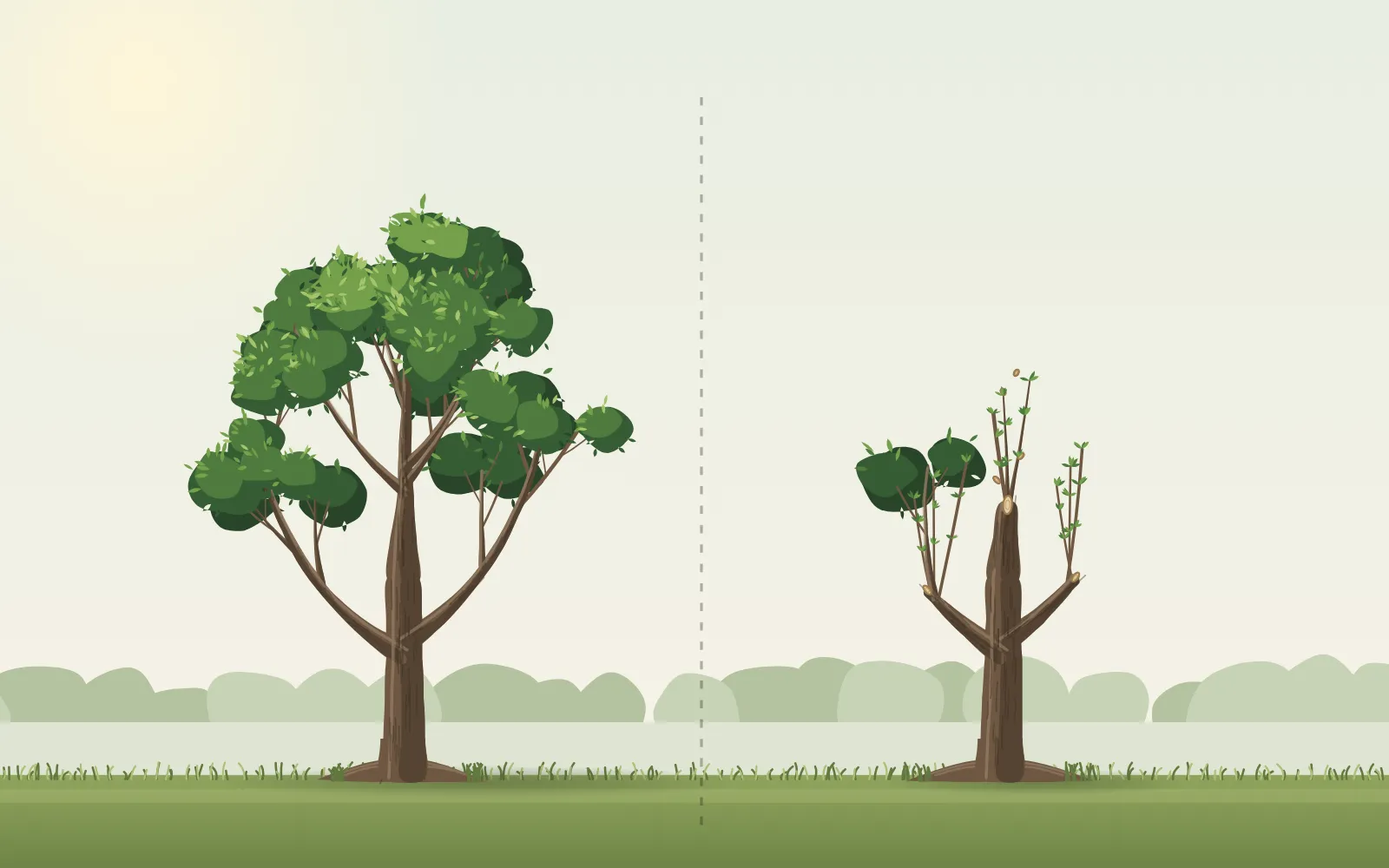
Drive through almost any neighborhood and you’ll see them: trees cut back to thick, flat-topped stubs, with clusters of thin shoots sprouting from the ends. That’s topping. It’s often sold as a way to make a tall tree safer or smaller, and it’s one of the most harmful things that can be done to a tree.
This isn’t a matter of taste. Professional arboriculture organizations, including the International Society of Arboriculture (ISA), advise against topping. Accepted industry pruning standards (ANSI A300) don’t treat it as a legitimate pruning practice.
What topping is
Topping means cutting a tree’s main stems or large branches back to stubs, or to small side branches too small to take over, without regard for the tree’s structure. It goes by other names too: heading, hat-racking, rounding over, or “dehorning.” The goal is usually to reduce height quickly.
Why people ask for it
Most people who ask for topping have a real concern:
- The tree feels too big for its space.
- They worry it will fall on the house during a storm.
- It’s shading a garden or growing into utility lines.
- A neighbor had it done, or someone knocked on the door offering it.
These are all legitimate reasons to have a tree looked at. Topping just isn’t the right answer to any of them.
What topping does to a tree
It starves the tree. Leaves are a tree’s food factory. Topping can remove a large share of the canopy in one day, leaving the tree without the leaves it needs to make energy. It then has to draw on stored reserves to push out new growth.
It creates wounds the tree can’t close. Trees don’t heal the way people do. They wall off damaged wood and grow new wood over the wound. The large, flat stubs left by topping are hard for a tree to seal, and decay can move down into the trunk over time.
It triggers weak, fast regrowth. In response, a topped tree often sends up many shoots just below each cut. These sprouts grow quickly and are only shallowly attached to the outer layers of the stub, not anchored the way a normal branch is. As they grow heavier and the stub below them decays, they become more likely to break.
It can make the tree more hazardous, not less. Put those together, decay in the stubs plus fast-growing, weakly attached sprouts, and a topped tree can become more likely to shed limbs than it was before. The height often returns within a few years, so the problem hasn’t been solved.
It costs more over time. The regrowth has to be managed again and again. A topped tree may decline or need removal sooner. And a tree’s appearance, which adds real value to a property, is hard to restore.
It exposes bark to sun. Removing the canopy suddenly can leave bark that was shaded exposed to intense sun. In an Arkansas summer that can injure the bark on the upper stems.
What to ask for instead
If your concern is size, clearance, or safety, there are better tools.
- Crown reduction. Instead of cutting stems back to stubs, the arborist shortens them back to a side (lateral) branch large enough to take over as the new end of the limb. Industry guidance calls for a lateral at least about one-third the diameter of the stem being removed. The tree keeps its natural shape and grows from branches built to carry it.
- Clearance pruning. Removing or shortening only the branches that hang over the roof, crowd the house, or block a walk or drive.
- Structural pruning. On younger trees especially, guiding growth now prevents the “too big, too heavy” problems later.
- Deadwood removal. Often the branches that worry people most are dead ones, and they can be removed without harming the living canopy.
- A risk assessment. If you’re worried about the tree failing, have it evaluated. A professional assessment looks at defects, the tree’s condition, and what’s nearby. It may find that targeted pruning, monitoring, or other options address the concern.
- Removal and replacement. Sometimes a tree simply doesn’t fit its space. Removing it and planting a species suited to that spot can be the honest answer. That’s better than topping it every few years.
Crape myrtles: a special case
In the South, crape myrtles are topped so often that the practice has a nickname, “crape murder.” They survive it, but it leaves knobby stubs and whip-like shoots that flop under the weight of their flowers. If a crape myrtle is too big for its space, it can be reduced properly over time, or replaced with a smaller variety. Left to their natural form, crape myrtles develop beautiful trunks and structure.
Questions to ask any tree service
Before you hire anyone to prune a tree, ask:
- How will you make the cuts? Listen for “reduction cuts to lateral branches” and “cuts just outside the branch collar,” not “we’ll take it down to about here.”
- Do you follow ANSI A300 pruning standards?
- Will you put the scope in writing? It should say which trees, what work, and why.
- Will you use climbing spikes? Spikes wound the trunk. They’re for trees being removed, not trees being pruned.
- Who will do the work, and what are their qualifications?
A good arborist won’t just agree to top your tree. They’ll ask what problem you’re trying to solve, then offer a way to solve it that keeps the tree healthy.
General education only. Every tree, species, and site is different, and this article is not advice about a specific tree.
Worried about a tree’s size or safety? Learn about Professional Pruning and Tree Risk & Consulting, or call or text us to talk it through.