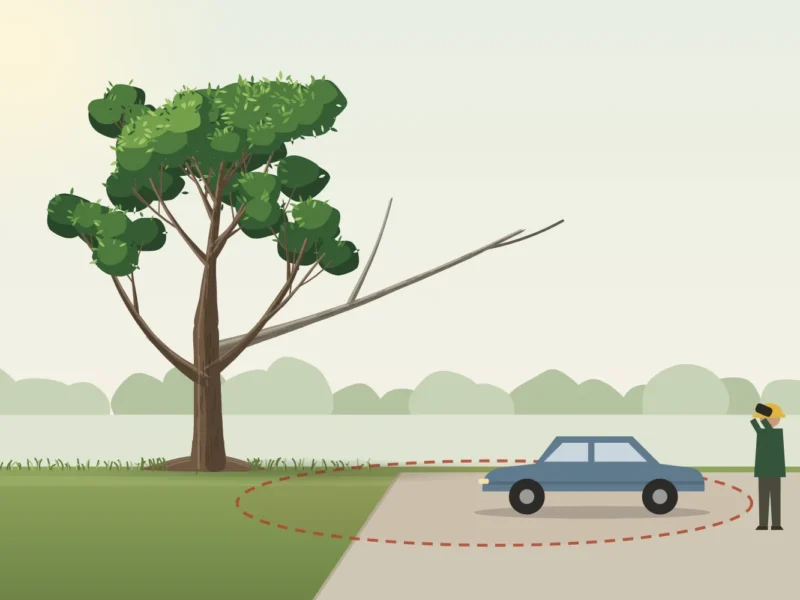
Tree risk assessment explained: TRAQ, duty of care, and the standard of care
What a professional tree risk assessment actually measures, what the ISA TRAQ credential means, and how the ideas of duty of care…

Tree risk consulting is a professional evaluation of a tree you’re worried about: its defects, what’s nearby, and your realistic options.
A crack, a lean, or a change in a tree can raise important questions. Start with context and professional evaluation.
Common requests

The Magnolia approach
A visible concern does not tell the entire story. The tree, the people and property nearby, and the limits of the assessment all matter.
Large dead limbs, cracks, cavities, or recent changes deserve context.
Leaning, root disturbance, and changes at the base can inform an evaluation.
Review damage and identify an appropriate next step for the property.
Consider trees before changes to soil levels, access routes, or nearby structures.
Recommendations may be informed by AIM, our system of baselines, measurements, and records kept over time. How AIM works
Common reasons people call
None of these automatically means a tree must come down. Each is a reason for a careful, professional evaluation.
Especially over roofs, drives, and play areas.
In the trunk, major unions, or large limbs.
Openings, soft wood, or fungal growth.
Trenching, grading, or damaged roots.
Especially with soil heaving at the base.
Hangers, torn limbs, and broken tops.
Planned work near valued trees.
Request an evaluation
A framework for decisions
Risk is understood in context. Each step adds a piece of the picture.
Species, size, condition, and history.
A defect, damage, or change to investigate.
People, property, and how the space is used.
Observations, limitations, and open questions.
Monitoring, care, site changes, or removal.
Our risk work is informed by the ISA Tree Risk Assessment Qualification held by co-founder Dillon Corson.
No assessment can guarantee a tree will remain safe or eliminate all risk. Findings relate to the scope and conditions at the time of evaluation.
How pricing works
Every tree and every site is different, so we don’t post prices. We look at the trees, talk through what you want, and put the scope and price in writing. Work begins only after you’ve agreed to it.
Your trees, your site, and what you’d like to change.
Which trees, what work, and what it costs.
Nothing starts until the scope and price are settled.
We map your trees in ArborNote and email you a clear work order on every job. See how transparent tree care works
Not necessarily. Depending on the findings, options may include monitoring, pruning, changing use of the surrounding space, further evaluation, or removal.
No. Trees are living systems, conditions change, and assessments have limits. An evaluation supports informed decisions; it cannot eliminate all uncertainty or risk.
Keep people away from the area. For a life-threatening emergency, call emergency services. Stay clear of trees or branches near utility lines and contact the utility provider.
Keep reading
What a professional tree risk assessment actually measures, what the ISA TRAQ credential means, and how the ideas of duty of care…
Continue exploring
Let’s start with a conversation
Tell us what you’re noticing. We’ll help you understand it—and decide what, if anything, should happen next. We reply to every request the same day.
Have photos or a video of the tree? Text them to (870) 340-2074.


