A tree that fails can injure people or damage property. When a tree worries you, a professional tree risk assessment turns that worry into a clear, documented picture: how likely the tree is to fail, what it could hit, how serious that would be, and what your options are.
This article explains what an assessment involves, what the TRAQ credential means, and how two terms you may hear, duty of care and standard of care, fit in.
What a tree risk assessment measures
A tree risk assessment is a structured evaluation of a tree, or a specific part of it, in its setting. The method taught by the International Society of Arboriculture (ISA) looks at three things together:
- Likelihood of failure: how likely a branch, the trunk, or the roots are to fail within a stated time frame. ISA rates it as improbable, possible, probable, or imminent.
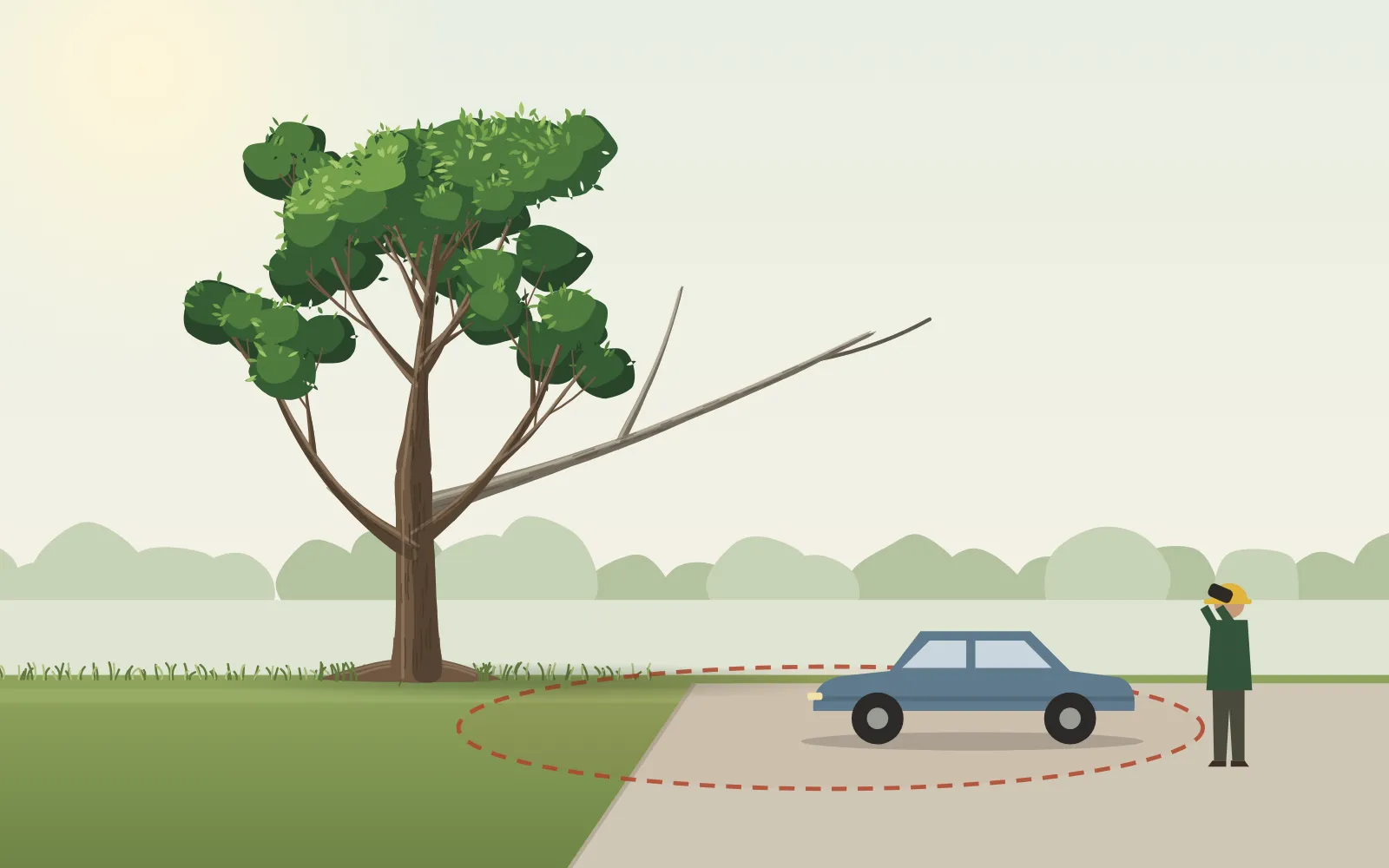
- Likelihood of impact: how likely the failed part is to strike a target, meaning the people, property, or activities within striking distance of that part of the tree (the target zone). Rated from very low to high.
- Consequences: how serious the harm or damage would be, from negligible to severe.
These are combined into a risk rating of low, moderate, high, or extreme.
A defect by itself does not make a tree high-risk. The same cracked limb is a very different risk over an empty field than over a driveway, a walkway, or a playground. That is why the assessment always looks at the tree and its surroundings together.
Three levels of assessment
Industry standards describe three levels of tree risk assessment, from least to most detailed:
- Limited visual: a quick look to find obvious problems, such as dead trees or large dead limbs. Useful for screening many trees.
- Basic: a detailed visual inspection of the tree and its site from the ground, sometimes with simple tools such as a mallet or binoculars.
- Advanced: specialized tools or techniques to learn more about a specific concern, such as decay inside the trunk or the condition of the roots. It is recommended when a basic assessment can’t answer the question.
The level should be agreed in writing before the work starts, because it defines what the assessment covers, and what it doesn’t.
What a written assessment should include
A good assessment is written down. Using ISA’s approach, it typically records:
- The tree, its location, and the targets in its target zone.
- The defects and conditions observed, for each part of the tree that is a concern.
- A risk rating for each concern, and an overall rating for the tree.
- Mitigation options, such as pruning out a dead limb, reducing a heavy branch, moving the target, or removal.
- The residual risk expected after mitigation. Only removing the tree takes its risk to none; every standing tree carries some risk.
- The time frame the assessment covers, typically one to five years, and when to reassess.
- Any limitations, such as parts of the tree that couldn’t be seen, and whether an advanced assessment is recommended.
What TRAQ means
The ISA Tree Risk Assessment Qualification (TRAQ) is a voluntary qualification that trains tree care professionals in ISA’s standardized, systematic process for assessing tree risk, based on ISA’s Best Management Practices: Tree Risk Assessment.
- Who can take it: candidates must already hold a credential such as ISA Certified Arborist or ISA Board Certified Master Arborist, or have a degree in arboriculture, urban forestry, or a related field.
- How it’s earned: a two-day course, followed by written and performance-based assessments.
- How it’s kept current: holders must retrain and retest every seven years.
Like other ISA credentials, TRAQ can be verified online. It’s worth asking for when you need a tree’s safety evaluated, especially when a decision about removal, a neighbor’s concern, or an insurance question is involved.
Duty of care: the tree owner’s side
In general, the law expects people to take reasonable care not to harm others, and that includes the trees on their property. But the details vary a great deal from state to state:
- North Carolina: NC State Extension explains that a court may ask whether a reasonable person would have known a tree was dangerous (for example, dead or visibly dying, leaning toward a neighbor’s property, or with damaged roots), and whether the owner acted unreasonably by leaving it standing. Storm damage to a tree that was already ailing may be seen as foreseeable rather than an "act of God."
- Georgia: UGA Extension explains that an owner is generally liable only with prior knowledge that the tree was dangerous, and that there is no general duty to inspect. A written report from an arborist can establish that knowledge.
- Busy places versus remote ones: a review of court decisions in the Journal of Arboriculture found that courts have expected more inspection of trees in developed areas, where more people and property are exposed, than of natural trees in rural areas.
What this means in practice: if you notice warning signs such as dead limbs, a new or changing lean, cracks, or fungus at the base, don’t ignore them. Have the tree assessed, keep the written findings, and follow through on the recommendations. Records of what was found and what was done show that the tree was managed with care.
Standard of care: the professional’s side
Standard of care is the level of care that a reasonably prudent professional would use in the same situation. For arborists, industry standards such as ANSI A300 and ISA’s best management practices set out what the profession considers acceptable practice, which is why a careful assessor follows them.
The written scope matters here too. Which trees were assessed, which targets were considered, and which level of assessment was performed together define what a professional was asked to do, and what can reasonably be expected from the findings.
Honest limits
- No tree is risk-free. Mitigation reduces risk; it can’t eliminate it while the tree is standing.
- Findings apply to a point in time. An assessment covers the conditions when it was done and a stated time frame. Storms, construction, drought, and decline can change a tree’s condition, which is why reassessment is part of the plan.
- A visual assessment can’t see everything. Decay inside a trunk or problems below ground may need an advanced assessment to evaluate.
- This is not legal advice. How duty of care applies depends on your state and your situation. For a question about liability in Arkansas, Tennessee, or anywhere else, talk with an attorney licensed there.
How we approach tree risk
At Magnolia Tree Care, our risk work is led by co-founder Dillon Corson, an ISA Board Certified Master Arborist who holds the ISA Tree Risk Assessment Qualification. We agree the scope and level of assessment with you first. You get written findings, the realistic options, and a recommended time to look again. When a property is monitored over time, the same records become part of AIM, so each reassessment builds on the last.
Sources
- International Society of Arboriculture. ISA Tree Risk Assessment Qualification (prerequisites, course and assessments, seven-year renewal).
- International Society of Arboriculture (2025). Using the ISA Basic Tree Risk Assessment Form (likelihood and consequence ratings, risk ratings, time frame, mitigation, residual risk, limitations).
- Branan, R. A. (2022). Tree Fall Liability: Who Is Responsible for Property Damage? NC State Extension.
- Toal, K., Blackmon, L., Sheffield, M. C., and Bauske, E. M. (2022). Tree Ownership and Responsibility (C1099). University of Georgia Cooperative Extension.
- Anderson, L. M., and Eaton, T. A. (1986). Liability for Damage Caused by Hazardous Trees. Journal of Arboriculture 12(8).
- Komen, J. (2022). Wielding the A300 Standards as a Shield. Tree Care Industry Magazine.
General education only. This is not legal advice. Every tree, property, and situation is different.
Worried about a tree? Learn about our Tree Risk & Consulting service, or call or text us to talk it through.