In Arkansas, the question isn’t whether strong wind will come, but when. On March 28, 2020, an EF3 tornado with 140 mph winds crossed Jonesboro, damaging homes, businesses, the mall, and the airport. Every spring brings thunderstorm winds that bring down limbs and whole trees.
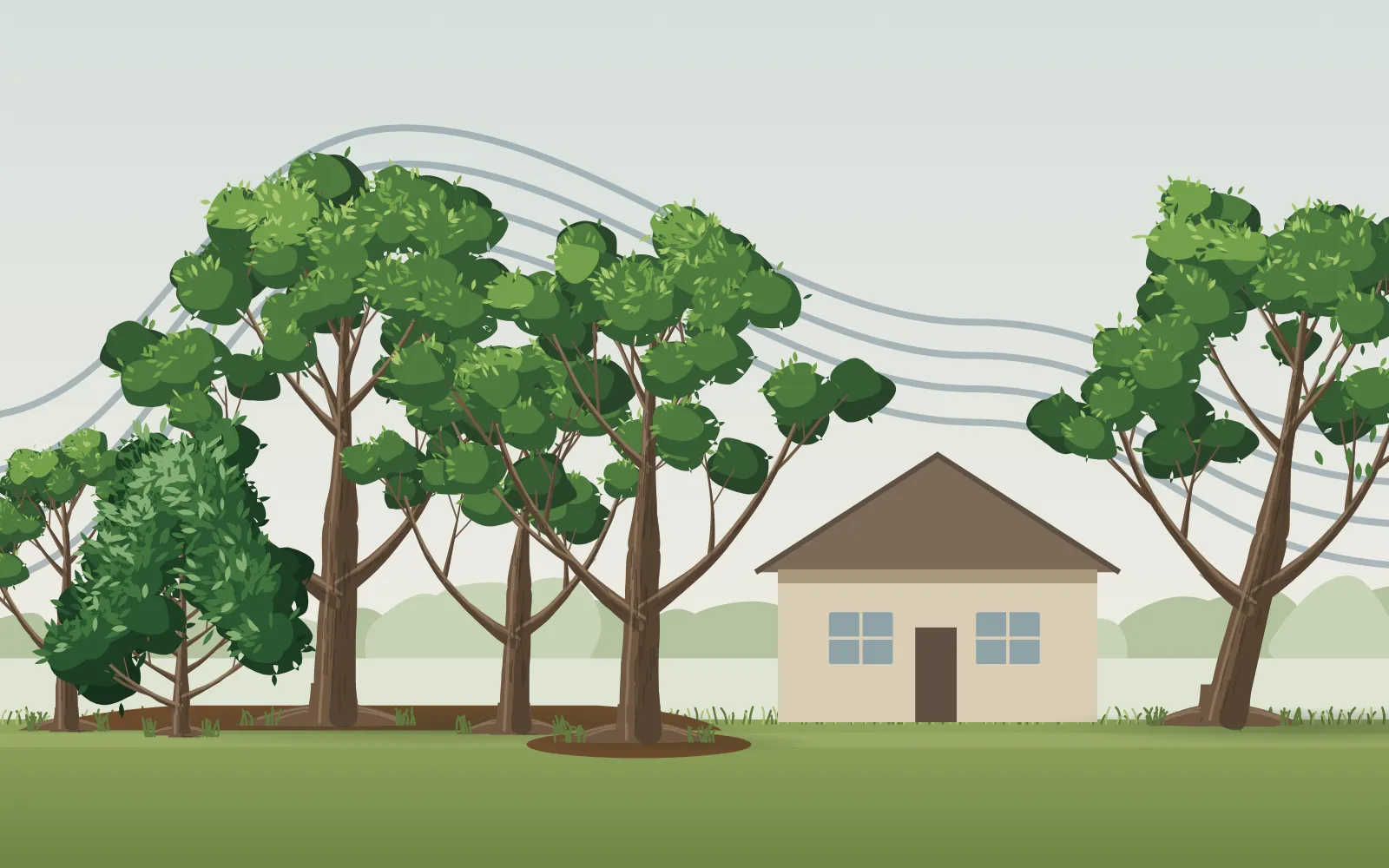
Most of us think about trees and storms after the damage. But some of the most useful decisions are made years earlier, on planting day: what to plant, where, and, it turns out, whether a tree stands alone or with company. Research on real storms points the same way: trees in groups survive wind better than trees standing by themselves.
What the wind looks like here
The National Weather Service in Little Rock keeps the state’s storm records. A few facts set the scene:
- Arkansas averages 37 tornadoes a year (based on 1991 to 2020).
- Most are weak. From 2000 through 2024, 81% of the state’s tornadoes were rated EF1 or lower, and those caused 3 to 4% of tornado deaths. The strongest, EF3 and above, were only 3 to 4% of tornadoes but caused 80% of the deaths.
- Craighead County has recorded 53 tornadoes since 1950. The counties with 50 or more cluster along Interstate 30 and U.S. 67/167, from Benton and Little Rock up to Jonesboro.
- Tornadoes are most likely in the afternoon and evening from March through May, with a second season in November and December.
Tornadoes get the headlines, but NOAA notes that damaging straight-line winds from thunderstorms are much more common than tornadoes. A downburst is a rush of air that hits the ground and spreads out; a small, intense one (a microburst) can produce winds up to 168 mph. Straight-line winds can even leave a tree looking twisted, because one side of the crown catches more wind than the other, which is why people often mistake wind damage for a tornado.
So the wind most Arkansas yards will face is strong straight-line wind and weaker tornadoes. That’s exactly the range where how a tree was planted, and what grows around it, makes a measurable difference.
What hurricane research found
The largest body of real-storm data on yard and street trees comes from the University of Florida, whose researchers surveyed thousands of urban trees after a series of hurricanes and published the lessons for the Southeast. Among them:
- Trees in groups survived better than trees standing alone. In Hurricane Ivan, 80% of trees growing in groups survived versus 70% of individual trees; in Hurricane Jeanne, 88% versus 78%. Their recommendation: plant trees in groups of at least five rather than one at a time.
- Trees with more rooting space were less likely to fail. They suggest at least 10 by 10 feet of rooting area for a small tree, 20 by 20 for a medium tree, and 30 by 30 for a large one, with about 3 feet of soil depth.
- Well-pruned trees survived better. Among broadleaf trees, survival was 73% for properly pruned trees and 47% for unpruned ones. Topped trees, and trees with two equal stems joined by included bark, were especially vulnerable.
- Older trees were more likely to fail, and so were unhealthy trees and trees whose roots had been damaged.
- Some species resist wind better than others. Of the species on their Southeast list that also grow well in Arkansas, southern magnolia and bald cypress rated highest; red maple rated medium-high; and water oak, pecan, and Bradford pear rated lowest.
- Saturated soil matters. A slow-moving storm that drops a lot of rain leaves less friction between roots and soil to hold a tree up.
Their bottom line is worth repeating: no tree is perfectly wind-proof, and soil, tree health, age, past care, and the wind itself all play a part. These were Florida hurricanes, not Arkansas thunderstorms, but wind pushes on a tree the same way everywhere.
Why neighbors help: how trees move in wind
A 2024 study in the journal Forest Ecology and Management looked more closely at the mechanics. Researchers monitored two plots of Japanese cedar for two years, one plot planted twice as densely as the other. Then Typhoon Trami hit in 2018. The dense plot came through undamaged; the thinned plot lost trees.
Their sensors showed that trees move in two ways. In light wind, the branches do the work, swaying quickly and absorbing energy. In strong wind, the whole tree begins to sway slowly as one piece, and the force travels down into the trunk and roots. Trees in the thinner plot switched into that risky whole-tree sway at lower wind speeds, because they had fewer neighbors to limit their movement. When the researchers measured the thinned trees’ actual wind resistance, it was only 48% of what their size predicted, and they attributed the gap to roots weakened by repeated large swaying in the winds before the typhoon.
In plain terms: neighbors limit how far a tree can swing, so its roots take less of a beating, storm after storm. That was a plantation forest in Japan, not a lawn in Craighead County, but it explains what the hurricane surveys saw.
Trees can shelter a house, if they’re in the right place
In 2026, engineers at Florida International University tested full-size trees around a one-story house in the university’s Wall of Wind, a facility that can reproduce hurricane-force wind. With common trees (pines, oaks, and palms) standing in the wind’s path, the wind force on parts of the house dropped by as much as 50%.
There was a catch. At some wind angles, trees increased the pressure on parts of the roof and walls, likely because of how the wind funneled between them. The researchers said more testing is needed. The lesson for a tree owner is that a group of trees can act as a windbreak, but placement matters, and a tree that could reach the house if it failed is a question for a tree risk assessment, not a guess.
Mixing species helps too
A 2017 review of forest research found that mixing broadleaf trees into conifer stands increased resistance to windstorms compared with pure conifer stands, while noting that the benefit is less clear for the very largest disturbances. The University of Florida team reached a similar recommendation for yards and streets: plant a variety of species, ages, and layers, which also protects against pests and drought, since no single problem can take out everything at once.
Honest limits
- No planting protects against a violent tornado. EF3 and stronger tornadoes cause 80% of Arkansas tornado deaths, and they will take trees, groups or not. Your shelter plan is a safe room or an interior room, not a tree.
- A group is not a guarantee. In the hurricane surveys, some trees in groups still failed. Groups shift the odds; they don’t remove them.
- The wrong tree is still the wrong tree. A group of Bradford pears is a group of weak trees. The University of Arkansas Extension describes the Bradford pear’s crown as poorly formed, with many limbs rising from one point, a weak spot that makes it prone to breaking up in a strong storm, and the tree is invasive in Arkansas besides. Water oak and pecan rated low for wind resistance too.
- Groups still need room. A group is not a thicket. Each tree needs its own rooting space, and the whole group needs to be far enough from the house, the lines, and the neighbors that a failure doesn’t become a claim.
Planting a yard that holds up in Arkansas wind
- Plant in groups of at least five, not one specimen in the middle of the lawn. Give each tree the rooting space above, and let the group share a wide mulched bed rather than lawn up to every trunk.
- Mix species, sizes, and ages. Canopy trees, smaller trees, and shrubs in layers. Our Planting for Wildlife lists give native choices for each part of our service area.
- Choose wind-tested species and skip the weak ones. Southern magnolia and bald cypress rated highest in the hurricane research; Bradford pear, water oak, and pecan rated lowest.
- Protect the roots. Keep trenching, grading, parking, and piles of fill off the root zone, and don’t bury the root flare under a mulch volcano.
- Prune for structure while the tree is young, so it grows one strong leader and well-spaced branches. Never top a tree to make it “safer.”
- Plan for age. Older, larger trees are more likely to fail, so have them assessed and plant the next generation now, so the group has young trees coming up as the old ones decline.
- After a storm, check carefully. Our storm safety checklist covers what to look for and what to leave to professionals.
How we approach it
Our Tree Planting service starts with the site and the mature size of each tree, and we’re glad to design a group planting rather than a single specimen. For properties we monitor over time, AIM records each tree’s condition year by year, so a lean that wasn’t there last spring, or a root zone that has been disturbed, gets noticed before the next storm season.
Sources
- Duryea, M. L., Kampf, E., Salisbury, A., Hauer, R., Klein, R., Andreu, M., Koeser, A., and Vinson, A. Wind and Trees: Lessons Learned from Hurricanes (FOR118). University of Florida IFAS Extension. (Trees in groups; rooting space; pruning; age; species wind resistance; saturated soil.)
- Kamimura, K., Nanko, K., Matsumoto, A., Ueno, S., and Gardiner, B. (2024). Energy transfer during tree movement for different wind conditions and forest configurations. Forest Ecology and Management. Summarized in the Shinshu University release.
- Florida International University (2026). FIU researchers find trees can shield homes from storms. (Wall of Wind tests; up to 50% less wind force on parts of a house; higher pressure at some angles.)
- Jactel, H., Bauhus, J., Boberg, J., Bonal, D., Castagneyrol, B., Gardiner, B., González-Olabarria, J. R., Koricheva, J., Meurisse, N., and Brockerhoff, E. G. (2017). Tree Diversity Drives Forest Stand Resistance to Natural Disturbances. Current Forestry Reports 3.
- National Weather Service, Little Rock. Severe Weather in Arkansas (yearly average, tornado strength and deaths, counties, timing); Arkansas tornadoes by county since 1950; 2020 significant events: tornadoes in March (the Jonesboro tornado).
- NOAA JetStream. Thunderstorm Hazards: Damaging Wind. National Weather Service, Northern Indiana. Straight-line winds versus tornado damage.
- University of Arkansas System Division of Agriculture, Cooperative Extension Service. Bradford Pears are Invasive Trees in Arkansas (invasive; poor crown structure and storm breakage).
General education only. Every tree, property, and storm is different, and this article is not advice about a specific tree.
Thinking about planting? Learn about our Tree Planting service, or call or text us to talk it through.