Plant Health CareThe problem above ground may begin below it.

Plant health care finds out why a tree is struggling—soil, roots, water, pests, or site changes—and then manages the cause, not just the symptom.

Healthy trees depend on more than healthy leaves. Soil, roots, water, and the surrounding environment all shape the story.

Common requests

  • A tree that is yellowing or thinning
  • Decline after construction or grading
  • Soil, root, or drainage problems
  • Insect or disease concerns

Serving Jonesboro and Northeast Arkansas (NEA), Memphis, Little Rock, Bentonville, and surrounding areasISA Board Certified Master Arborist®

Illustration: a leafy tree with its root zone opened up to show a mulch ring, soil layers, roots, and a soil probe
Our specialty

The Magnolia approach

What shapes a tree’s health.

A yellow leaf alone cannot tell the whole story. We look at the factors that work together—above and below ground—before recommending anything.

  • Soil

    Structure, pore space, and biology set the foundation.

  • Roots

    Most absorbing roots live in the top foot of soil.

  • Water

    Too little and too much can look surprisingly alike.

  • Compaction

    Crushed pore space starves roots of air and water.

  • Drainage

    Saturated soil changes how roots function.

  • Insects

    Identified in context—not assumed from a single sign.

  • Disease

    Many symptoms overlap; confirmation matters.

  • Canopy symptoms

    Where below-ground stress often becomes visible.

  • Nutrient availability

    Often a soil question, not a fertilizer question.

  • Environmental stress

    Heat, drought, and site change add up over time.

Plant health care is one of the actions AIM can lead to, not the same thing. AIM is the evidence around it: a baseline before, and a re-check after that shows whether the care helped. How AIM works

The soil–plant–atmosphere continuum

A tree is
one connected system.

Water enters through the soil, climbs through roots and trunk, and leaves as vapor from the canopy—while sugars travel back down to feed the roots. A problem anywhere shows up everywhere.

How a tree works as one connected system A mature tree above layered topsoil and clay subsoil. Roots spread wide and shallow, past the canopy’s dripline. A cutaway of the trunk shows bark, phloem, cambium, sapwood, and heartwood. Blue dotted lines show water moving up from the soil to the leaves and out as vapor; amber lines show sugars moving down to the roots. H₂O vapor out CO₂ inO₂ out DriplineDripline Roots reach well beyond Most fine rootslive up here Clay subsoil:few roots, less air Mulch ring, flare visible 6 Atmosphere 5 Canopy 4 Trunk 3 Water transport 2 Roots 1 Soil
Water & minerals up (xylem) Sugars down (phloem) Conceptual illustration, not to scale.

Select a layer Soil → Atmosphere

01Soil
Healthy: air + water spacesCompacted: pores crushedBlue = water film around soil grains

The foundation

Healthy soil is roughly half solid particles and half pore space—shared by air and water. Compaction crushes those pores, so roots can’t breathe or drink, even when it rains.

What we look for

  • Compaction from traffic, parking, or construction
  • Drainage: waterlogged or bone-dry pockets
  • Grade changes or fill over the root zone
02Roots
Root tipRoot hairsMycorrhizal fungi

Wide, shallow, and hard-working

Most absorbing roots grow in the top foot or so of soil and often spread two to three times the canopy’s radius—well past the dripline. Fine root tips and partner fungi (mycorrhizae) do the absorbing.

What we look for

  • A visible root flare at the soil line
  • Girdling or circling roots
  • Trenching, digging, or paving in the root zone
03Water transport
Xylem vessels: water rises as one connected column

One unbroken column

Water and minerals rise through the xylem in a continuous column, pulled upward as leaves release water vapor. Break the supply below, and the top of the tree feels it first.

What we look for

  • Seasonal water availability
  • Drought stress or saturated soil
  • Dieback that starts at the top
04Trunk
Bark: protectionPhloem: sugars downCambium: new woodSapwood: water upHeartwood: supportWounds affect it all

The living conduit

The working part of a trunk is a band just under the bark: phloem carries sugars down, the cambium makes new wood and bark, and sapwood carries water up. Heartwood at the center gives support. Wounds and cankers can interrupt both flows.

What we look for

  • Bark wounds and mower or string-trimmer damage
  • Cankers, cracks, or decay
  • Soil or mulch piled against the trunk
05Canopy
Sunlight → sugars (photosynthesis)Stoma: water vapor outCO₂ in

Where the story shows

Leaves turn sunlight, carbon dioxide, and water into sugars, releasing water vapor through tiny pores (stomata). Leaf symptoms often reflect a problem somewhere else in the system.

What we look for

  • Leaf color, size, and density
  • Where dieback appears: top, one side, or scattered
  • Insect or disease signs—identified, not assumed
06Atmosphere
Cool, humid: slow water lossHot, dry, windy: fast loss

The demand from above

Heat, low humidity, sun, and wind pull water from leaves faster. On an Arkansas July afternoon, a large tree can move a remarkable amount of water—and the roots must keep up.

What we look for

  • Heat waves and drought periods
  • New sun and wind exposure after nearby removals
  • Reflected heat from pavement and buildings

How we think through a tree problem

Care built around the tree,
not a sales quota.

We don’t arrive with a work order already in mind. Each visit follows the same careful sequence, so recommendations come from evidence—and sometimes the right answer is to wait and watch.

  1. 01

    Observe

    What changed, where on the tree, and since when?

  2. 02

    Site & history

    Construction, grading, irrigation, weather, and past work.

  3. 03

    Soil & root zone

    Compaction, drainage, root flare, and disturbance.

  4. 04

    Canopy & structure

    Growth, dieback, and branch architecture.

  5. 05

    Pests & disease

    Signs identified in context—never assumed.

  6. 06

    Recommendation

    The right work for this tree—or none at all.

Growing in Arkansas

Local conditions.
Connected effects.

Our landscapes bring long, hot summers, periodic drought, heavy clay soils, and plenty of construction. More than one stress is often involved when a tree begins to decline.

Look at the whole picture
Heat & drought

Hot, dry conditions can strain the balance between water available to roots and water lost through leaves.

Compacted & poorly drained soil

Compaction, drainage problems, digging, and construction can alter the air and water roots depend on.

Oaks & decline

Decline can involve interacting stresses. A thinning oak canopy is a reason to investigate, not a diagnosis by itself.

Boring & scale insects

Insects are often secondary to stress. They require identification and context before any management is considered.

Fungal & nutrient symptoms

Leaf spots, cankers, and discoloration can look alike. Confirmation matters before choosing a response.

Start with what you see

What is your tree
telling you?

A symptom is a clue, not a conclusion. Choose what you’ve noticed to see what might be involved—and why a closer look matters.

Yellow leaves

If you’re seeing

Yellow leaves

Leaf color alone rarely identifies the cause.

Possible contributors

  • Too little—or too much—water
  • Root damage or compacted soil
  • Soil pH and nutrient availability
  • Normal seasonal change
  • Symptoms can have multiple causes.
  • The visible symptom may not be the root cause.
  • A proper assessment considers the tree and its surrounding site.
Request a Tree Health Assessment
Thinning canopy

If you’re seeing

Thinning canopy

A pattern that often develops over several seasons.

Possible contributors

  • Root disturbance or construction
  • Drought and heat stress
  • Repeated defoliation
  • Age-related or site-related decline
  • Symptoms can have multiple causes.
  • The visible symptom may not be the root cause.
  • A proper assessment considers the tree and its surrounding site.
Request a Tree Health Assessment
Dead branches

If you’re seeing

Dead branches

Where the dieback appears is an important clue.

Possible contributors

  • Natural shading and shedding
  • Root or trunk injury
  • Cankers or decay
  • Boring insects, often after stress
  • Symptoms can have multiple causes.
  • The visible symptom may not be the root cause.
  • A proper assessment considers the tree and its surrounding site.
Request a Tree Health Assessment
Holes or sawdust

If you’re seeing

Holes or sawdust

Hole shape, size, and location narrow the possibilities.

Possible contributors

  • Wood-boring insects
  • Woodpecker feeding
  • Decay around old wounds
  • Carpenter ants in already-decayed wood
  • Symptoms can have multiple causes.
  • The visible symptom may not be the root cause.
  • A proper assessment considers the tree and its surrounding site.
Request a Tree Health Assessment
Mushrooms at the base

If you’re seeing

Mushrooms at the base

Fungal fruiting bodies can indicate decay—or nothing serious.

Possible contributors

  • Decay in roots or the lower trunk
  • Buried wood or organic matter
  • Harmless soil fungi
  • Symptoms can have multiple causes.
  • The visible symptom may not be the root cause.
  • A proper assessment considers the tree and its surrounding site.
Request a Tree Health Assessment
Bark changes

If you’re seeing

Bark changes

Some bark changes are completely normal growth.

Possible contributors

  • Normal bark shedding with growth
  • Mechanical or sun injury
  • Cankers
  • Cracks after temperature swings
  • Symptoms can have multiple causes.
  • The visible symptom may not be the root cause.
  • A proper assessment considers the tree and its surrounding site.
Request a Tree Health Assessment
Leaf spotting

If you’re seeing

Leaf spotting

Many leaf spots are cosmetic; some are not.

Possible contributors

  • Fungal or bacterial leaf diseases
  • Insect feeding
  • Weather or chemical injury
  • Symptoms can have multiple causes.
  • The visible symptom may not be the root cause.
  • A proper assessment considers the tree and its surrounding site.
Request a Tree Health Assessment
Premature leaf drop

If you’re seeing

Premature leaf drop

Timing and which leaves drop first both matter.

Possible contributors

  • Drought stress
  • Leaf diseases
  • Root stress
  • Extreme weather
  • Symptoms can have multiple causes.
  • The visible symptom may not be the root cause.
  • A proper assessment considers the tree and its surrounding site.
Request a Tree Health Assessment

General education only. Several causes can look alike; identifying what is affecting a specific tree requires an on-site assessment.

Care starts at the base

Two easy fixes most trees need.

Most people never see what separates professional tree care from a quick job. These are the details that decide how a tree grows—and how long it lives.

MulchingA little mulch helps. A volcano hurts.

Mulch volcano: moisture against bark, rot, circling roots✕ Common mistake
  • Mulch piled against the trunk holds moisture on the bark, invites rot and pests, and encourages circling roots.
2–4 in. deep, wide as practical, pulled back from trunkFlare stays visible✓ Proper practice
  • Spread 2–4 inches deep, as wide as practical.
  • Keep it a few inches back from the trunk so the flare shows.
  • It moderates soil temperature, holds moisture, adds organic matter, and keeps mowers and trimmers away.
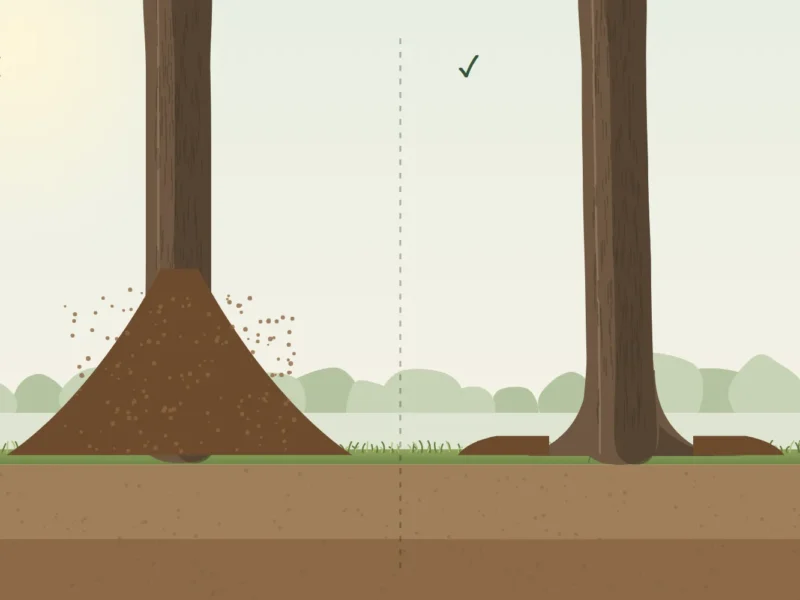
Root flareA tree should look like it’s standing on its roots.

Soil piled on the trunkBuried flare & girdling rootBuried flare: bark stays wet; roots can circle✕ Common mistake
  • When the flare is buried—by soil, mulch, or planting too deep—bark stays wet and girdling roots can form and constrict the trunk.
Trunk widens into rootsRoot flare visible at the soil line✓ Proper practice
  • A healthy trunk widens where it meets the roots.
  • If you can’t see a flare, it may be buried. An arborist can check with a careful root collar excavation.

General education based on widely published arboricultural practice. The right approach for a specific tree depends on its species, condition, and site.

Mulch calculator

How much mulch do you need?

Enter the size of the ring around your tree, or of a bed, and how deep you’ll spread it. The math: cubic yards = square feet × depth in inches ÷ 324.

Keep mulch off the trunk, 2 to 4 inches deep.

What are you mulching?
1.05 cubic yards of mulch For about 113 sq ft at 3 inches · roughly 15 bags of 2 cubic feet

A ring’s area is 3.14 × radius × radius. Bagged mulch is often sold in 2-cubic-foot bags; 27 cubic feet make one cubic yard. Buy a little extra to be safe.

Educational examplePlant health care

Change happens from the ground up.

Visible stress often traces back to the root zone. Compare a stressed tree with how a tree may look after the cause is diagnosed, the site is improved, and time is allowed.

BeforeVisible stress symptomsEducational illustration — Visible stress symptoms.1Thin, pale canopy, dieback3Compacted soil, few fine roots2Buried flare, no mulch132
AfterAfter diagnosis, site care, and timeEducational illustration — After diagnosis, site care, and time.1Fuller, greener canopy3Looser soil, more fine roots2Mulch ring, flare visible132
  1. Before: Thin, pale canopy, diebackAfter: Fuller, greener canopy
  2. Before: Buried flare, no mulchAfter: Mulch ring, flare visible
  3. Before: Compacted soil, few fine rootsAfter: Looser soil, more fine roots
Drag the handle—or use arrow keys—to compare. Educational example, not a Magnolia project. Results vary by tree, site, condition, and management approach.

How pricing works

Agreed in writing before work begins.

Every tree and every site is different, so we don’t post prices. We look at the trees, talk through what you want, and put the scope and price in writing. Work begins only after you’ve agreed to it.

  1. 01
    We look and listen

    Your trees, your site, and what you’d like to change.

  2. 02
    A written scope and price

    Which trees, what work, and what it costs.

  3. 03
    Work begins when you agree

    Nothing starts until the scope and price are settled.

We map your trees in ArborNote and email you a clear work order on every job. See how transparent tree care works

A little more clarity

Common questions.

Ask about your tree
Can a photograph identify the problem?

Photographs can provide useful context. Many symptoms overlap, and an on-site assessment or further testing may be needed to understand the cause.

Does a stressed tree always need treatment?

No. A recommendation may involve site changes, monitoring, further investigation, or a specific management option. Treatment is not a substitute for understanding the cause.

How quickly will a tree respond?

Response varies with the tree, the underlying issue, the site, and the management approach. No outcome or timeline can be guaranteed.

Let’s start with a conversation

Your trees have a story.
We’re here to listen.

Tell us what you’re noticing. We’ll help you understand it—and decide what, if anything, should happen next. We reply to every request the same day.

Have photos or a video of the tree? Text them to (870) 340-2074.

  • Jonesboro and Northeast Arkansas (NEA), Memphis, Little Rock, Bentonville, and surrounding areas
  • Licensed, bonded & insured